Real-time Groundwater Monitoring Around Natural Gas Drill Sites in Colorado

The Center for Energy Water Sustainability (CEWS) at Colorado State University, in partnership with Noble Energy, has developed a real-time groundwater monitoring system in the Denver-Julesburg basin of Colorado called the Colorado Water Watch (CWW).

The Colorado Water Watch is a state and privately funded program brought together by a team of engineers and scientists from the Center of Energy Water Sustainability, making it a neutral third party to measure the impact of natural gas drilling on the surrounding groundwater supplies.

The goal of the project is to gather groundwater monitoring data in real time, and analyze and report it in real or near-real time, depending on whether the data requires further evaluation. The project is designed to bridge the gap between fears about public health impacts caused by oil and natural gas development and the assumption that industry environmental and health practices are reliable.

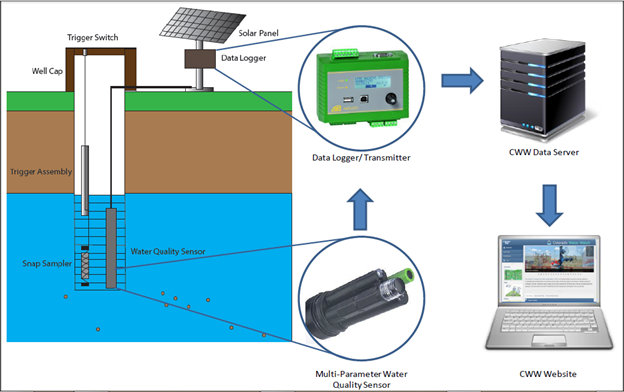
To achieve this goal of real-time groundwater monitoring and transmission, the Colorado Water Watch employs the Hydrolab MS5 multiparameter sonde, OTT netDL data logger, and OTT ecoLog 800 groundwater level and conductivity sensor.  Click here to see live data from the project.
groundwater logger monitoring
Example of how data from the Hydrolab MS5 is sent to the OTT netDL data logger and transmitted to the CWW website.


You might also like these articles

An expansive solar panel array stretches across a desert landscape, with sand dunes shaping the horizon. Hazy sunlight filters through, casting a warm glow over the scene, illustrating the intersection of technology and the environment.

Soiling, Performance Risk, and Capacity Testing in Utility‑Scale Solar

Why Measurement Strategy Matters More Than Ever Executive Summary Soiling is a well‑established cause of energy loss in photovoltaic (PV) systems. Less widely recognized is its impact during capacity and performance...
Solar Energy
Reducing Pyranometer Error

Reducing Pyranometer Error: Why Irradiance Accuracy Starts in Plant Design, Siting & Construction

Accurate irradiance data is the backbone of  solar project performance, bankability, and long-term investor confidence For EPCs, it shapes everything from yield assessments and energy modeling to commissioning acceptance tests and contractual guarantees. But this...
Solar Energy
Bridgestone World Solar Challenge

Harnessing Sun and Wind: Solar Team Twente’s Journey to Second Place

When Solar Team Twente crossed the finish line of the 2025 Bridgestone World Solar Challenge in second place, they didn’t just prove the power of solar energy – they demonstrated...
Solar Energy