OTT Rain Gauges Used in Remote Precipitation Monitoring Stations in Andes Mountains

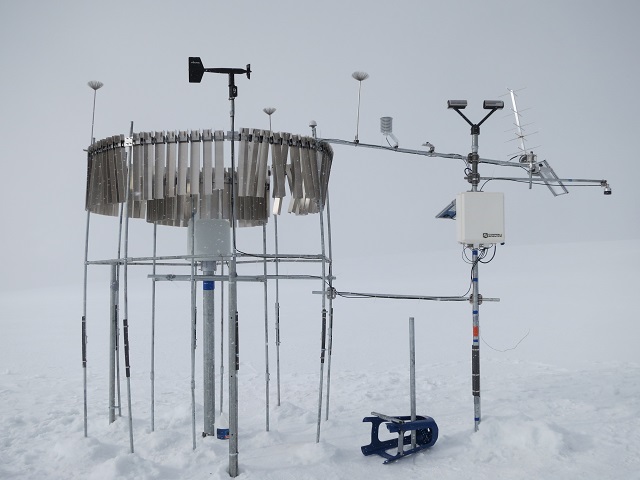
The completed weather station at 18,537 ft in Peru. OTT Pluvio and Parsivel can be spotted on the left and right.

There are remote monitoring locations, and REMOTE monitoring locations!

Appalachian State University, in partnership with a multitude of other universities and the National Science Foundation, has undertaken the task of installing weather monitoring stations very high up in the Andes Mountains, on the Quelccaya Icecap (18,537 ft (5,650 m) ) in Peru and at Chacaltaya (16,929 ft (5,160 m) ) in Bolivia. Both stations included the OTT Pluvio2 Weighing Precipitation Gauge and the OTT Parsivel2 Weather Laser Disdrometer.

View of the installation site in Bolivia

Installing the weather stations at such high altitude was a challenge in itself. The Quelccaya Icecap station required over 500 lbs (225 kg) of equipment to be hauled up by foot! The stations will be helpful in improving scientific understanding of precipitation processes and patterns, the meteorological influences on chemical and isotopic properties preserved in the snow/ice, and the influence of precipitation on glacier dynamics in the region. Researchers are able to monitor weather conditions and station status via satellite telemetry so less hikes up to the station are required.

See some of the amazing photos below, and visit the Appalachian State blog to see more photos, videos, and background on the monitoring project!

Weather Station Installation at the Quelccaya Icecap in Peru

Weather Station Installation at Chacaltaya in Bolivia

Carrying galvanized steel pipe for mounting OTT weather sensors up to 18,537 ft in Peru
The completed weather station at 18,537 ft in Peru. OTT Pluvio and Parsivel can be spotted in the background.
The completed weather station at 18,537 ft in Peru. OTT Pluvio and Parsivel can be spotted on the left and right.

You might also like these articles

Reducing Pyranometer Error

Reducing Pyranometer Error: Why Irradiance Accuracy Starts in Plant Design, Siting & Construction

Accurate irradiance data is the backbone of  solar project performance, bankability, and long-term investor confidence For EPCs, it shapes everything from yield assessments and energy modeling to commissioning acceptance tests and contractual guarantees. But this...
Solar Energy
Bridgestone World Solar Challenge

Harnessing Sun and Wind: Solar Team Twente’s Journey to Second Place

When Solar Team Twente crossed the finish line of the 2025 Bridgestone World Solar Challenge in second place, they didn’t just prove the power of solar energy – they demonstrated...
Solar Energy
Plaza de Mulas is the base camp at the foot of Aconcagua, the highest mountain in the southern hemisphere (6,961 meters), located in the Mendoza Province of Argentina.

Met Tech World Expo 2025 Now in Video

Explore our exclusive video library from the Meteorological Technology World Expo 2025 – packed with expert insights, innovative technologies, and practical applications shaping the future of environmental monitoring. Dive into...
HydrologyMeteorology